Problem
Many businesses handle requests through email, WhatsApp, spreadsheets, and manual follow-ups. This creates lost information, poor visibility, slow response times, and no central reporting.
Full-Stack TypeScript Demo
A full-stack TypeScript business operations platform for managing client service requests, internal workflows, dashboard reporting, content updates, and activity tracking.
Demo credentials are provided in my CV or cover letter so reviewers can explore the role-based workflow.
Product preview
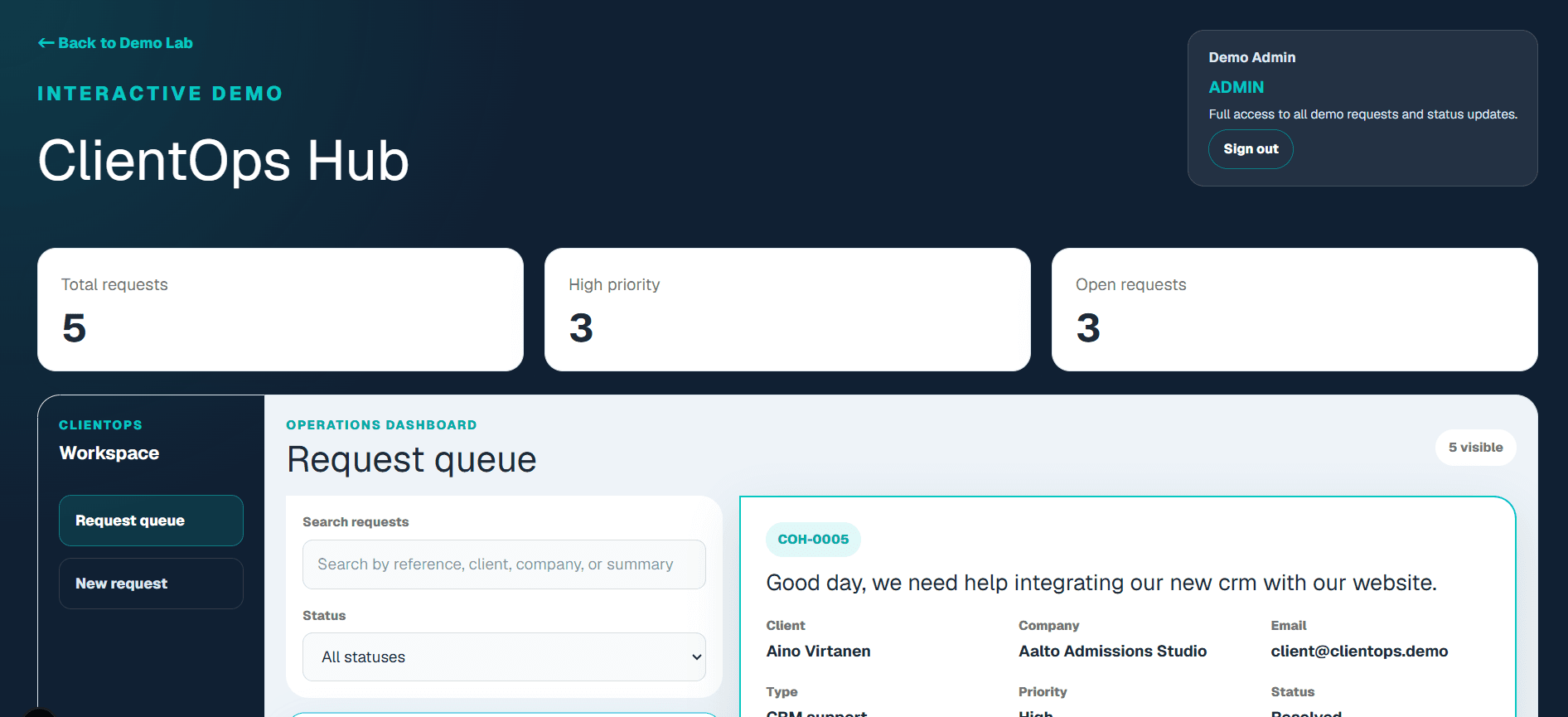
A quick visual snapshot of the kind of operational interface the demo is built around: metrics, request cards, assignment, notes, and activity history.
Many businesses handle requests through email, WhatsApp, spreadsheets, and manual follow-ups. This creates lost information, poor visibility, slow response times, and no central reporting.
ClientOps Hub gives the business a structured request intake system, protected demo access, role-based request visibility, status tracking, dashboard metrics, and activity logs backed by a PostgreSQL database.
Product workflow
The demo is structured around the daily work a business needs to manage: intake, visibility, follow-up, and traceability.
Demo users can sign in and create structured requests with priority, request type, and message details. Client users are locked to their own company identity.
Admin and agent users can view live request metrics, open requests, high-priority items, and operational summaries from the database.
Staff can search, filter, inspect request details, assign ownership, add internal notes, and update workflow statuses while client users stay in a read-only status view.
Request creation, internal note creation, and status changes are recorded with timestamps and actors so the system has a clear operational history.
Implementation stack
These are the tools and platform decisions behind the build, grouped by where they fit in the system.
Engineering decisions
This section explains the choices I would discuss in an interview: architecture, data model, APIs, security, delivery, and the trade-offs behind the MVP.
The system is built as a Next.js App Router application with protected demo routes, server-side request handling, Auth.js sessions, and a Prisma database layer behind the workflow.
The data model is centered on client requests, assignment ownership, demo users, internal notes, and request activity records stored in AWS PostgreSQL through Prisma.
The backend uses typed route handlers for request listing, request creation, assignment updates, internal notes, and status updates with server-side authorization checks.
The demo uses Auth.js credentials login, seeded users, bcrypt password hashing, protected routes, and role-based access control.
The project includes a GitHub Actions workflow that checks the application before deployment.
Testing starts with business logic that can be verified without a browser or database, then can expand into API and workflow coverage.
The demo focuses on the highest-signal workflow for interview review: authentication, request management, role-based access, and persistent data.
The next improvements focus on deeper validation coverage, richer records, and clearer client communication.